Moving forward with Good Agricultural Practice This is the fourth instalment in a series of…

China Market Update for South African Pecan Nut Producers Association NPC
August 14, 2026
Economic Update
- Summary: China’s official Q2 2026 GDP growth came in at 4.3% year-on-year moderating from the 5.0% recorded in Q1. This brought first-half growth to 4.7%, keeping the economy within the government’s annual target range of 4.5%-5.0%. According to the National Bureau of Statistics, the Q2 slowdown was partly affected by short-term factors and external influences on certain industries. Officials also noted that in nominal terms, Q2 GDP grew 5.9% year-on-year-accelerating by 1% point from Q1-with incremental output exceeding Q1 by RMB 400 billion. The underlying economy fundamentals and new growth drivers, particularly high-tech manufacturing, continue to strengthen.
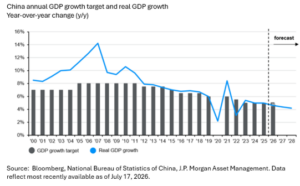
The “two-speed” pattern persisted in Q2. Exports, advanced manufacturing, and state-led investment remained primary growth drivers. In Q2, equipment manufacturing and high-tech manufacturing posted year-on-year growth of 9.7% and 14.0%, respectively, both accelerating from Q1 levels. However, domestic demand recovery remained fragile. In Q2, retail sales growth averaged 0.2% year-on-year, down 4.2 percentage points from the same period last year. On a monthly basis, retail sales fell to -0.6% in May before recovering to 1.0% in June. Persistent headwinds from subdued household confidence and property market pressures continued to weigh on consumption
- Consumption Power, Consumer Confidence and Prices: Consumer prices continued their moderate upward trend through the second quarter. The consumer price index (CPI) rose 1.1% year-on-year in Q2, up from 0.9% in Q1, marking the third consecutive quarter of expansion since late 2025. Core CPI, excluding volatile food and energy prices, remained at or above 1% for most months, reflecting gradual demand-side price drivers. However, the April CPI reading of 1.2%—above economists’ forecast of 0.9%—appears to have been partly influenced by elevated input and energy costs linked to geopolitical factors. The June CPI eased to 1.0% year-on-year, largely due to falling global gold and oil prices, with domestic gold jewelry and gasoline prices down 8.7% and 4.9% month-on-month, respectively.
Domestic consumption growth continues to lag the broader economy. Total retail sales rose just 1.3% year-on-year in the first half of 2026, with Q2 monthly figures showing renewed softening: April retail sales grew only 0.2% year-on-year, followed by a contraction of -0.6% in May, before recovering slightly to 1.0% in June. This volatile trajectory underscores persistent fragility in household demand, in contrast to the 4.7% GDP growth recorded in H1.
Consumer confidence improved modestly from recent lows but remains weak by historical standards. The consumer confidence index stood at 89.0 in April, 89.9 in May, and edged down to 89.4 in June—well below the 100 threshold that signals optimism. May Day holiday data offered mixed signals: domestic trips rose 3.6% year-on-year to 325 million, and total tourism spending increased 2.9% to RMB 185.5 billion, yet per-trip spending declined slightly from a year ago and remained below pre-pandemic levels. Economists caution that such holiday-driven bursts have repeatedly failed to translate into a durable recovery in household consumption.
- Currency: The renminbi continued its appreciation trend against the U.S. dollar through Q2 2026, with the pace of appreciation accelerating from early 2026. The monthly average exchange rate moved from around 6.90 RMB per USD in Q1 to approximately 6.84 RMB per USD by June, with the central parity rate strengthening by 1,085 basis points over the quarter—from 6.9194 at end-March to 6.8109 at end-June . By late June, the yuan was trading around 6.82 per dollar, representing a roughly 3% appreciation from end-2025 . The RMB also appreciated against the euro (2.06%) and the yen (2.89%) during the quarter . The currency’s strength was underpinned by robust export performance—with the first-half trade surplus reaching US$575.98 billion —though policymakers signaled growing caution about the pace of appreciation, with the PBoC emphasizing two-way flexibility and stability at a reasonable equilibrium level going forward.
China Nuts Industry Update: May through August 2026
2026 CFNA Tree Nuts Conference held in Yiwu, China
On August 6-7, 2026, the 2026 CFNA Tree Nuts Conference, hosted by the China Chamber of Commerce of Import and Export of Foodstuffs, Native Produce and Animal By-Products (CFNA) and organized by Yiwu Market Development Group, held in Yiwu. This marked the first time the conference was held in Yiwu, with over 800 industry participants from more than 20 countries and regions in attendance.
The conference featured nearly 110 exhibition booths, with participants including local Yiwu companies, domestic nut brands such as Qiaqia Food, Three Squirrels, Wolons, and Be & Cheery, as well as a number of international nut companies.
At the opening ceremony on August 6, Cao Derong, President of the China Chamber of Commerce of Foodstuffs and Native Produce, delivered a keynote address. According to his presentation, in the first half of 2026, China’s nut imports totaled 129,500 tons, a year-on-year decrease of 1.42%, while import value reached US$1.064 billion, up 23.38% year-on-year. During the same period, nut exports amounted to 233,000 tons, an increase of 6.67% year-on-year, with export value reaching US$1.09 billion, up 19.1% year-on-year. This was the first time that China’s nut export value exceeded its import value. It was also projected that China’s nut and seed snack market would exceed RMB 320 billion in 2025 and could reach RMB 430 billion by 2029.
China’s Domestic Pecan Production
A summary of China’s pecan production was presented at the 19th CFNA Tree Nuts Conference in Yiwu in August. Experts at the conference estimated that this year’s harvest could reach as high as15,000 tons, with a conservative forecast exceeding 12,000 tons, double that of last year. The geographic distribution is as follows:

China’s pecan industry is undergoing a strategic northward shift. While traditional production areas—including Yunnan, and Anhui’s Hefei, Chuzhou and Fuyang, as well as Suzhou and Suqian in Jiangsu—remain key (each typically yielding about 200,000 kg), suitable climate conditions north of the Huaihe River (e.g. Fuyang, Suzhou and Suqian) are positioning these regions as potentially optimal cultivation zones, with Shandong’s Qingdao and coastal areas also actively expanding plantings.
Export growth has been strong: total imports last year were around 3,000 tons, but exports in the first half of this year alone have already reached 3,000 tons. With the peak consumption season still ahead, annual exports are expected to double to 6,000 tons.
China Pecan Market Update
Deming Lin, GM of Hangpai Food Co., Ltd., gave a speech on China’s pecan market at the August conference. He outlined two key trends currently shaping the sector. First, the supply structure is shifting: in 2024, imported pecans accounted for approximately 95% of China’s supply, while domestic production represented 5%. By 2025, the import share declined to 90%, with domestic supply rising to 10%. This shift is not attributable to weakening consumption, but rather to the accelerating ramp-up of local production capacity.
Second, consumption patterns are evolving. Pecan consumption in China is transitioning from a seasonal festive product—traditionally marketed as in-shell nuts for Spring Festival gifting (2000–2018)—to a daily nutritional food item. Since 2019, the market has seen increased demand for kernel products, greater health awareness, and more diversified consumption scenarios. Younger demographics are incorporating pecans into office snacks, breakfast meals, afternoon tea, and post-exercise nutrition.
In addition, pecans exports from China are expanding into overseas markets, with primary destinations including Southeast Asia, Central Asia, and the Middle East. In 2025, pecan exports from China registered a year-on-year increase of 15.2%.
Fresh Nut Kernels Gaining Traction in China
China’s nut consumption market is showing increasing consumer interest in fresh nut kernels.Fresh macadamia kernels and fresh almond kernels are already available in the market. More recently, fresh pecan kernels have also appeared on retail shelves – they are now sold on Freshippo (Hema), one of China’s leading new-retail platforms. Freshippo ranked second among supermarket brands in China by sales in 2025 and operates an O2O (online-to-offline) retail model.
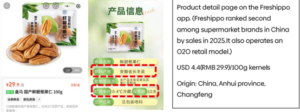
In addition, fresh snack chain stores are expanding rapidly across China. These stores typically offer products with no artificial preservatives that require refrigeration – a format well suited to fresh nut kernels.
China Imposes Provisional Anti-Dumping Deposits on U.S. & Mexican Pecans
On August 10, the Chinese Ministry of Commerce issued a notice stating that, in accordance with the provisions of the Anti-Dumping Regulations of the People’s Republic of China, an anti-dumping investigation was initiated on September 25, 2025, against imports of pecans originating in Mexico and the United States (Ministry of Commerce Announcement No. 52 of 2025).
Based on the investigation findings and pursuant to Article 24 of the Anti-Dumping Regulations, the Ministry of Commerce has made a preliminary ruling. The Ministry has preliminarily determined that pecans imported from Mexico and the United States are being dumped in China, that the domestic pecan industry has suffered material injury, and that there is a causal relationship between the dumping and the material injury.
In accordance with Articles 28 and 29 of the Anti-Dumping Regulations, the Ministry of Commerce has decided to impose provisional anti-dumping measures in the form of security deposits. Effective August 11, 2026, importers of pecans originating in Mexico and the United States are required to provide security deposits to the Customs of the People’s Republic of China at the deposit rates determined for each company in this preliminary ruling. The deposit is calculated on an ad valorem basis using the customs duty value of the imported goods, with the following formula:
Deposit Amount = (Customs Duty Value × Deposit Rate) × (1 + VAT Rate at Import Stage)
Deposit Rates by Company
| Company Name | Deposit Rate (Dumping Margin) |
| I. Mexican Companies | |
| (i) Sampled Mexican Companies | |
| NEGOCIO AGRÍCOLA SAN ENRIQUE S.A. DE C.V. | 23.0% |
| VINEDOS ALTA, S.A.P.I. DE C.V. | 17.8% |
| (ii) Other Cooperative Mexican Companies | |
| Premium Pecanas S.A. de C.V. | 22.2% |
| VINAS DE LA COSTA SA DE CV | 22.2% |
| AGROPECUARIA OQ, SA DE CV | 22.2% |
| NUECES OKO SA DE CV | 22.2% |
| (iii) All Other Mexican Companies | 51.6% |
| II. U.S. Companies | |
| All U.S. Companies | 54.3% |
Related Posts