From an initial allocation of 160 trees to four farmers in 2014, SAPPA’s transformation programme…

Help Track Cape Parrots in Pecan Orchards
Sharing the harvest: Help us track Cape Parrots in pecan orchards
By Dr Francis Brooke, Research Manager, Cape Parrot Project
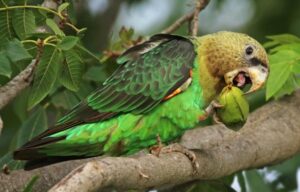
Clad in the green and gold of South Africa’s national colours, the Cape Parrot (Poicephalus robustus) is a South African special. Fewer than 2 000 individuals remain in the wild, with their decline driven by a combination of threats, including continued habitat fragmentation, current and historical logging practices targeting hardwood trees used for nesting sites, the prevalence of a highly contagious viral disease and the capture of individuals for the illegal pet trade. Being an endemic species, Cape Parrots are found only within the borders of our country, being further restricted to naturally fragmented Afrotemperate forests of the Eastern Cape, KwaZulu-Natal and Limpopo provinces. Whilst these forests are key for providing sites for breeding, roosting and feeding, Cape Parrots can, and often do, make use of resources beyond their natural forests. Once believed to feed almost exclusively on the kernels of yellowwood trees, recent research has revealed a far more varied diet of indigenous and exotic tree species (up to as many as 36 different species!) – with pecan nuts featuring strongly within their diet preference.

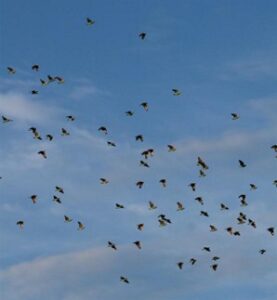
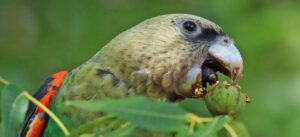
Cape Parrots can make long distance foraging forays (up to 80 km) from their natural forests to make use of fruiting pecan trees and orchards within the broader landscape – gathering in large flocks (as many as 600 individuals in a single incident). The Cape Parrot Project, a project of the Wild Bird Trust, has set out to gain a greater understanding of Cape Parrot use of pecan orchards. The Cape Parrot Project (CPP), founded in 2009 in the small village of Hogsback in the Amathole mountains of the Eastern Cape, and recently expanded into the Limpopo province, actively works to conserve these threatened birds through research, habitat restoration and community engagement and education. By examining large flocks of Cape Parrots that gather at pecan orchards, information obtained can provide insights into the age and sex ratio of the population as well as the prevalence of disease within the population. In an attempt to expand our research and knowledge on Cape Parrot use of pecan orchards, the project has set out to understand where pecan orchards occur in the landscape within Cape Parrot distribution, how parrots interact with the orchards, and the perceptions around Cape Parrots and their use of pecan orchards – all in an effort to guide effective conservation efforts.
 As part of this effort, CPP is currently running a short survey, and invites members of the greater SAPPA community to help contribute to CPP research. If you have seen Cape Parrots at your orchards, used to see them historically, or fall within the Cape Parrot range but do not see them, we would highly value your input. An online survey can be accessed by scanning the QR code with your phone, and should only take approximately 10 minutes to complete. Alternatively, you are welcome to make contact via email at francis@wildbirdtrust.com. The conservation of this unique species will be greatly strengthened by insights from the SAPPA community, and all contributions are warmly welcomed.
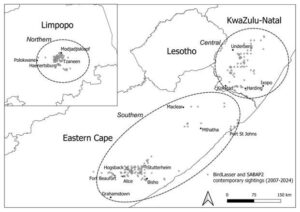
Photo credits:
Cape Parrot with pecan – Rodnick Biljoen
Cape Parrot flock – Obakeng Pule
Rodnick Biljoen

Related Posts