When SAPPA first shared Ebrahim Mohamed’s story in February 2023, it introduced readers to a…

China Market Update – January 2026
China Market Update for South African Pecan Nut Producers Association NPC
January 29, 2026
Economic Update
- Summary: China met its official 5% GDP growth target in 2025, largely driven by a surge in exports that more than offset weakness in domestic demand. Consumer inflation was flat for the year despite a late-year uptick, producer prices remained in deflationary territory, and corporate margins continued to face pressure. While official data point to a resilient headline economy, several independent analysts argue that underlying growth may be overstated, highlighting a two-speed or “K-shaped” economy in which external demand and manufacturing continue to outperform domestic consumption.
- GDP and Output: China’s official 2025 GDP growth was 5%, matching both the 2024 rate and the 2025 target. Some independent consultancies (e.g., Rhodium Group, Capital Economics) have questioned the official figures and estimated actual 2025 GDP growth in the range of 2.5% to 3.5%. While views differ on the precise level of growth, there is broad agreement that 2025 growth was driven primarily by exports rather than increased domestic consumption.
According to the Wall Street Journal, “Exports made up 33% of China’s economic growth last year, according to the statistics bureau, the highest share since 1997… China’s customs agency reported a record $1.19 trillion trade surplus for 2025, driven by a 5.5% increase in exports.”
Official fourth-quarter GDP growth slowed to 4.5% year-on-year, the weakest quarterly rate in nearly three years, indicating a deceleration after a first half of the year supported by government consumption subsidies and an export surge as producers and U.S. customers stockpiled inventory ahead of anticipated U.S. tariffs.
Investment weakened sharply toward the end of 2025. Fixed-asset investment (FAI) declined 3.8% for the year, marking the first annual contraction in decades. This reflected a deepening property slump and tighter constraints on local government borrowing, which curtailed one of China’s traditional growth drivers.
Despite these developments, Goldman Sachs continues to forecast GDP growth of 4.8% in 2026. However, this growth is again expected to be driven by exports and not necessarily to translate into a material improvement in domestic consumption.
Industrial output rose 5.2% year-on-year in December, pointing to continued strength in export-oriented manufacturing.
- Consumption Power, Consumer Confidence and Prices: Chinese consumers remained under pressure throughout 2025, weighed down by falling housing prices, which eroded household wealth, and by a weak labor market. Despite repeated government pledges to prioritize domestic consumption, consumption growth missed expectations.
According to CNBC: “Retail sales grew 0.9% in December from a year earlier, missing economists’ forecast for 1.2% growth and slowing from 1.3% in the prior month. That marked the softest growth since December 2022, according to Wind Information, when the gauge of consumption declined 1.8% year-on-year.”

Source: CNBC, via National Bureau of Statistics
Consumer confidence improved marginally toward the end of the year but remained near all-time lows.
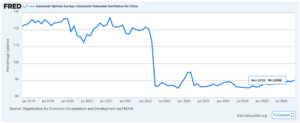
Price data reinforce the picture of weak demand. The consumer price index (CPI) rose 0.8% year-on-year in December, but this increase was insufficient to offset deflationary pressures earlier in the year. CPI was flat for 2025 as a whole, according to the National Bureau of Statistics. Food prices declined 0.7% over the year, while fresh fruit prices rose 1.2%. Nuts are not broken out separately in CPI data.
Deflationary pressure remains a major concern for China’s economy. The Wall Street Journal has characterized China as having entered a deflationary “doom loop,” in which falling prices, squeezed corporate profits, and weak wage growth reinforce subdued domestic demand.
- Rise of the “K-Shaped” or “Two-Speed” Economy: China’s economic performance in 2025 further reinforced a “K-shaped” or “two-speed” growth pattern. On one side, export-oriented manufacturing, advanced industrial equipment and technology-linked sectors continued to expand, supported by strong external demand and policy support. On the other, the domestic consumer economy remained subdued, with intense price competition and limited purchasing power.
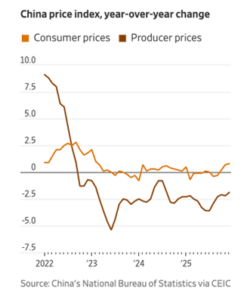
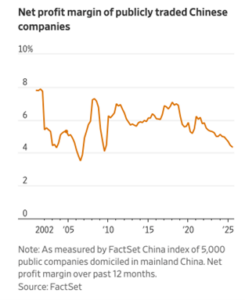
Producer price inflation (PPI) remained in deflationary territory throughout 2025, underscoring persistent downward pressure on factory-gate prices and fierce competition among manufacturers. This has translated into thinner margins across much of the domestic supply chain and has limited companies’ ability to raise wages or expand hiring. As a result, income growth has lagged output growth, reinforcing weak consumption dynamics.
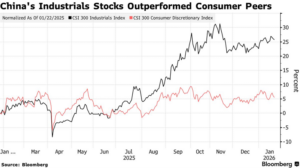
Looking ahead, most forecasters expect China’s incremental growth over the next few years to continue to come disproportionately from industrial output and exports rather than domestic consumption. While the drag from the property sector may lessen in 2026 as the pace of decline slows, analysts broadly expect the housing market not to reach a clear bottom until 2027. Until then, the negative wealth effect on households is likely to persist.
- Currency: The RMB has generally appreciated against the USD since April 2025. The exchange rate slipped from a high of around 7.35 RMB per 1 USD to 6.95 on January 29, 2026. Goldman Sachs predicts the RMB will undergo slight appreciation against the USD in 2026.
Sources:
BBC: China hits growth goal after exports defy US tariffs
Bloomberg: A Tale of Two Economies Is Reshaping China’s Stock Market
CNBC: China’s investment crash raises credit risks for homebuilders, banks, government: Fitch
The Economist: “Which Chinese provinces splash their cash?” Jan. 24-30 issue
Goldman Sachs: China’s Economy is Expected to Grow 4.8% in 2026 Amid Surging Exports
National Bureau of Statistics, China: Consumer Price Index in December 2025
The Wall Street Journal: The Deflation Doom Loop Trapping China’s Economy
The Wall Street Journal: China Reports Robust Economic Growth, Thanks to Resilient Exports
Nuts Industry News Update—Q4 2025 and January 2026
China: Domestic Pecan Production Rising from a Small Base, but Agronomic Constraints Persist
USDA’s Tree Nuts Annual (CH2025-0198, Nov 21, 2025) reports that China’s domestic pecan production remains modest but is expanding rapidly, with in-shell output forecast at 6,000 MT in MY2025/26 (Sep–Aug), up more than 70% year-on-year, largely as more orchards enter bearing age. Pecans are planted across over 80,000 hectares in Anhui, Jiangsu, and Yunnan, though many trees have yet to bear or are yielding minimally. The report notes that late-June heat and heavy rains reduced yields in Anhui and Jiangsu, limiting what could otherwise have been higher output. Over the medium term, USDA highlights insufficient farming techniques—especially pest and disease control—as a key bottleneck, pointing to black spot disease outbreaks in MY2024/25 in the Yangtze River region. Industry sources cited by USDA also characterize pecans as the most difficult and costly tree nut to cultivate in China, with structurally lower yields than other nut crops.
Hainan Free Trade Port: Duty-Free Processing Hub Emerging for Nuts
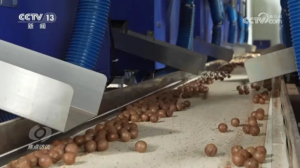
Since Hainan Free Trade Port (FTP) officially began island-wide customs closure on December 18, 2025, the province has accelerated its role as a processing and transit hub for agricultural imports, including nuts. Under the core “processing value-added exemption” policy, imported products can enter Hainan duty-free, and—if processed locally with at least 30% value added—be sold into mainland China tariff-free. This mechanism is already being applied in practice, including South African macadamia nuts, where local processing (roasting, seasoning, packaging, and use of recognized Hainan-origin inputs such as salt) helps reach the value-added threshold. The policy has been further strengthened by allowing cumulative value-added calculations across upstream and downstream firms, lowering the barrier for participation.
Source (Chinese-language): https://mp.weixin.qq.com/s/AnS1T8WTJGN3WbnSYvGirg
Sam’s Club Adds Pecans as a New Component in Spring Festival Gift Boxes, Featuring South African Origin
For the upcoming Spring Festival (Chinese New Year, Year of the Horse), Sam’s Club has introduced pecans as a new component in its premium gift box assortment. Product descriptions explain that pecans are rich in unsaturated fats and can be sensitive to oxidation if growing or storage conditions are suboptimal. As a result, the pecans selected for the gift box are sourced from South Africa, with Sam’s Club highlighting their higher maturity, more stable oil profile, and cleaner, naturally aromatic flavor. The origin is presented as a key quality differentiator in a major seasonal gifting product.

Key China 2026 Nuts Industry-Relevant Events
- The 19th Food Exhibition for Nuts and Dried Fruits, organized by CNA in Hefei, Anhui from April 17 to 19
- The 43rd INC World Nut and Dried Fruit Congress, Macao, May 14 to 16
- SIAL Shanghai, May 18 to 20
- The 2026 China International Tree Nuts Conference, organized by the China Chamber of Commerce of Import and Export of Foodstuffs, Native Produce and Animal By-Products (CFNA) in Yiwu, Zhejiang, August 5 to 8
Related Posts