13 Julie 2026 Saamgestel deur Kobus Hartmann Opsomming -Gebruik van plantgroeireguleerders, wat natuurlike fito-hormone en…

Regenerative Agriculture in Pecan Nut Cultivation
By: Corné Pieterse, Delpa Pecans (PTY) LTD
For: SAPPA
4 March 2025
Introduction
Looking at the world of agriculture from the last few decades there has been big news and headlines around organic agriculture, biological farming, and regeneration of landscapes. Most farmers have stayed the conventional farming course due to tried and tested methods. Methods that have found a reasonable level of success not only on their farm, but the neighbors farm and farmers in other provinces and even other countries. So if it isn’t broken, why fix it? Or why tamper with the income I am happy with?
For any farmer considering regenerative agriculture as an avenue to produce pecan nuts this is not one-size-fits-all. It is a mindset shift from following a book or manual to applying principles that are impacted by your resource concerns.
This is quite a mouthful, so to make this a bit more understandable, let’s go through what regenerative agriculture is, the principles surrounding it, and how you can apply it to your surroundings or farm.
Delpa Boerdery is located approximately seven kilometers outside Douglas on the R357 to Prieska. The farm is best known for its potato, wheat, maize and lucerne crops. In 2015, the farm embarked on its journey into pecans and regenerative agriculture by planting 70 hectares of cover crops aimed at soil nourishment and sand control. This was followed by an expansion to 145 hectares in 2016, an additional 50.6 hectares in 2018, and a further 49.85 hectares in 2019. The final bare root plantings of 55 hectares took place in 2020, bringing the total area under pecan cultivation to 420.45 hectares. Notably, the 50.6 hectares planted in 2018 underwent double planting of trees in 2019, and these trees were transplanted in 2022 to a neighboring 50-hectare pivot using a Dutchman tree spade. Delpa Pecans operations apply biological farming and the principles of regenerative agriculture.
What is regenerative agriculture?
Regenerative agriculture is a system of farming principles and practices that aim to:
- Restore and enhance ecosystem health:
It also works to improve water cycles and increase biodiversity overall. This primarily focuses on rebuilding soil organic matter and restoring soil biodiversity.
- Strengthen the health of the environment:
It aims to reduce the negative impacts of agriculture on the environment, such as soil erosion, water pollution, and greenhouse gas emissions.
- Produce healthy food:
By focusing on soil health, regenerative agriculture aims to produce more nutrient-dense food.
The overarching mission of regenerative agriculture is to create a more resilient and sustainable food system that benefits both people and the planet. Having resilient food systems makes sure that the increasingly unpredictable weather systems have less of a dramatic impact on production.
This involves:
* Improving soil health.
* Increasing biodiversity.
* Enhancing water quality.
* Sequestering carbon.
This sounds very complex but think of it as having a system that functions autonomously. The more you try to override the system, the more errors and bad functionality you get. While when you stimulate the system to work more on its own, the more efficiency you get.
Regenerative Agriculture Five principles:
Gabe Brown, an American farmer has put down these five principles as simple guidelines to use on his own farm and to train other farmers to implement regenerative agriculture on their properties.
Gabe Brown, emphasizes these five key principles:
- Minimize disturbance:
This includes minimizing tillage, which disrupts soil structure and reduces soil organic matter.
The keyboard here is to minimize soil disturbance. Depending on your soil, you might have to disturb the soil occasionally due to compaction, buildup of thatch layers in soil, or just to prep an orchard floor for planting.
- Armor the soil surface:
Keeping the soil covered with plant residues or cover crops helps protect it from erosion, regulate temperature, and retain moisture.
This is a very important point, especially for South Africans farming the northern Cape where swell temperatures can rocket during the summer. Ensuring that the soil is covered not only keeps your soil cool, but it also keeps your soil moist. Keeping your soil cool and moist also helps the diversity of your microbial population.
- Increase biodiversity:
While achieving heightened biodiversity within pecan nut orchards presents challenges due to the overwhelming dominance of pecan trees within their ecosystem, strategic integration of cover crops or intercropping practices can introduce a valuable secondary layer of cover. This secondary layer can serve as a source of sustenance for livestock, thereby fostering a more diverse and balanced ecological community within the orchard.
Cover crops, planted during the off-season, can enrich the soil with vital nutrients, enhance its structure, and attract beneficial insects that contribute to natural pest control. Intercropping, which involves cultivating compatible crops alongside pecan trees, can similarly augment soil health and attract pollinators, while potentially offering additional revenue streams.
The presence of livestock can aid in natural weed control, nutrient recycling, and soil aeration, while also offering economic diversification and potential for value-added products. By embracing these diversified and integrated practices, pecan nut growers can move towards a more resilient, productive, and ecologically sound orchard system.
- Maintain living roots year-round:
Having living roots in the soil from cover crops and improving soil structure increases water retention, and water infiltration into the soil. More roots equals more sugar in excreted roots sticking together. This is especially important in Sandy type soils to help fight against the erosion.
- Integrate livestock:
When managed properly, livestock can play a crucial role in cycling nutrients and stimulating soil health. The important thing about livestock is they can help you save on diesel, inputs, and implement wear and tear. The downside is that they do require management in this management needs to be integrated with Pecan tree management. They are not separate but intertwined.
How can I apply this on my farm?
Regenerative agriculture is most effective when tailored to the specific resource concerns of your farm or soil. In simple terms, this means understanding the challenges you need to address—whether it’s restoring the small water cycle, preventing erosion from wind or water, or improving soil health. While regenerative practices aren’t solely focused on reducing fertilizer inputs, many farmers find that as their system begins to function within these principles, the need for synthetic inputs naturally decreases.
Being able to measure a resource concern is important. The best indicators are the ones every farmer is already using:
- Production (t/ha)
- Leaf & SAP analysis
- Soil analysis (chemical, water, and biological)
- Water infiltration tests
- Soil coverage (if you have livestock)
- Organic matter (Organic Matter % & Active Organic Matter)
- Soil profile holes
- Any measurement you feel gives an indication of the direction your management is leading you.
Measurements should provide insight into whether you’re moving in the right direction. It is not about getting to a perfect number, but rather letting the numbers impact your management of your resources.
The first and best approach to this is to take each one of the five principles and see how they can be implemented on your farm.
Start with what you already do. Taking a look at Delpa Pecans management practices as an example of how to apply this as a practical way:
1. To keep the soil covered or armoured.
Covering the soil in this brittle and harsh climate is a real challenge. So, to adhere to this principle we aim to keep as much as what grows on an hectare on the hectare. We try to remove as little as possible and as practical. Pruned limbs are chipped and placed on the tree row with the chipper spout. Adding bigger chunks of carbon to not only hold moisture but give a foothold for fungi that are put through the irrigation system.
Here in Douglas we do not have too many choices of what we can add, except not to remove anything that grows, by leaving it to return to the ground as a covering. Like leaves dropping in autumn, flail mowing the weeds that leave tough stalks after sheep has been through a part of the orchard. This not only covers parts of the soil but gives the soil a chance to heat up evenly for the next cover or weed succession to grow evenly.
In the winter this is one of the hardest principals for us to apply. Especially between tree rows, on the tree row vetch grows and covers as much as the climate and the management of the sheep has allowed. Before harvest we try to get every development cut or grazed low to the ground in order to pick up all the nuts that go to ground. The little cover that is there does pose a harvest challenge.
We have decided that protecting our soil is more valuable than an easy task.
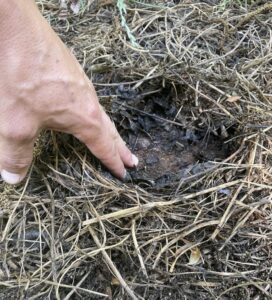
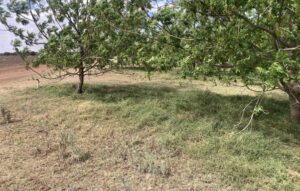
18 Dec 2024 – Armour peak during the start of summer (Photo 1)
Looking at Photo 1 above the stratification of layers from soil surface is: the fallen leaves of the prior season, followed by the cover (vetch) that has been eaten or trampled down to leave a carpet of cover under the trees. Through this carpet, we have different weeds that sprout and also later add to the armour or cover of the soil.
This stratification process lends to the darkening of the soil as you can see above. We will need to find processes to be able to keep the soil covered for longer times of the year that will fit into our area and climate that is more practical. But for now, the effects are evident.
2. To keep living roots in the soil at all times.
This is a challenge in most orchards, especially in the traditional pecan orchards. Most pecan orchards have a neatly maintained herbicide strip around the trees to combat weeds. We have inversely gone and sowed hairy vetch on the tree row in order to have living roots in the soil over the winter months. Not only does the vetch fixate nitrogen (N) but the root exudates have the ability to keep soil microbes alive and fed. Management of the vetch differs year to year depending on which site the sheep ran through last before they are taken out of the orchards to give the vetch time to grow. Below are a few photos of the progression of vetch during the 2024 growing season.
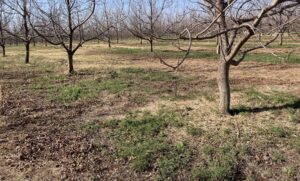
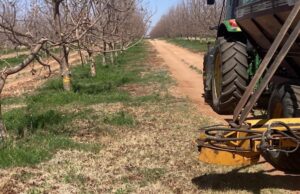
30 August 2024 – L18 (Photo 2)- This is around the time we apply our budding manure applications.
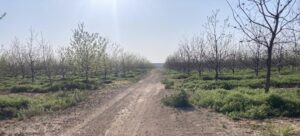
10 Sept 2024 – Still busy applying manure (Photo 3)- Vetch is starting to interweave to create a live carpet effect.
3 October 2024 – L18 (Photo 4)- Vetch enjoying the spring heat.
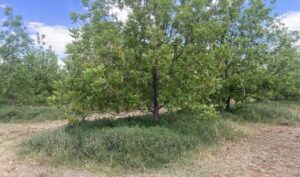
4 Nov 2024 – L18 Before sheep grazing (Photo 5).
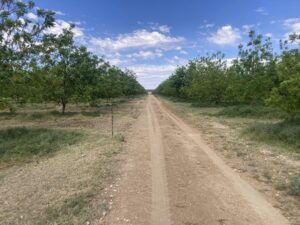
4 Nov 2024 – L18 (Photo 5) Top photo (Photo 4) is tree to the right bottom photo (Photo 6) are trees to left where sheep were grazing.
4 Nov 2024 – L18 (Photo 7) sheep were grazing and about to move to a new part of the orchard.
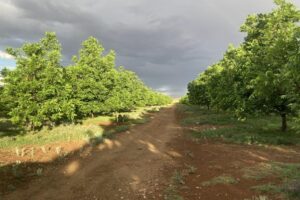
21 Nov 2024 – L18 (Photo 8) just a 100m up the road from (Photo 5), sheep have been moved to new pecan development, and the vetch is regrowing.
Using this method, we get the most out of the vetch. But even more impressive is that we see a type of natural succession from the vetch to rye grass and other grass like species in the tree row, to some milk thistle weeds, lambs quarter followed by knapsekerel (black jack weed). As the season starts to end, and the cold starts to creep closer the vetch starts the cycle again.
Leaving some vetch to reseed is an important management strategy we need to follow using the sheep. Since the sheep eat the more palatable vetch first along with the more palatable grasses. Then they move on to the weeds.
3. To minimize soil disturbance, avoid tillage and only spray when necessary.
Fortunately, tree crops have little use for soil disturbance. There would be instances on some soils where this might be a management tool to increase root development over time. But it is not something we have had any issue with.
4. Diversity of plants and roots in the soil.
As described in point two, keeping living roots in the soil at all times. We have found that a type of natural succession is formed by the different weeds, grasses and our cover crop vetch that promotes a diversity of plant roots and root exudates in the soil. This is a valuable asset but looking at measurable data on nematodes is also another risk a regenerative farmer needs to decide if he/she is going to take on. We have seen that having cover crops growing under pecan soils in South Africa that these orchards have a higher amount of total nematode populations than pecan orchards with a neat chemical strip or completely fallow orchard.
Consultants that do our nematode analysis have shown us data collected from different sites under the same management. Their goal was to determine under which management practice one gets more nematodes, fallow orchards (only pecan roots) or cover cropped orchards (with covers). They found more nematodes in the orchard sites with cover crops than those without.
This correlated with our high number of nematodes.
Yet if you assess the risk and the logic behind why this is possible, we again have opted to take the riskier approach, where the other producer has chosen a path with less risk.
When we look at the amount of nematodes in samples there are certain threshold limits which industry have found that beyond it damage could occur more easily on the economically important crop. We also need to follow the logic that if you feed one part of the soil microbiology food web, you are both directly and indirectly feeding other parts as well. This is where the soil food web needs to balance itself out. When we add fulvic acid, humic acid, fish hydrolysate, woodchips, pecan leaves in the winter or cover crops into our system we are feeding the soil food web of which nematodes make up a part. Since it is about competition, we want to make sure the good guys outcompete the bad as far as possible. Or provide plants, cover crops and weeds which have softer more desirable roots for nematodes. Therefore, just having higher numbers in the soil sample of your nematode analysis is not something that should give you sleepless nights- if you have provided alternative food sources (covers), added fungi that prey on nematodes, and increased the microbe diversity to make the competition for resources high in order to put these negative nematodes on the ropes.
If any nematodes are found in the root analysis of your nematode analysis. Act as soon as possible. There are many new biological products based on metabolites of Trichoderma that are being tested with great success that can be used before harsher chemical routes need to be used. Monitor and assess your risk.
Remember that diversity leads to balance and succession.
5. Livestock integration.
This is a simple concept where you use animals to do the work machinery would have done at an expense and turn it into an income per hectare. The sheep that are run on the pecan hectares cuts grass, trims trees, controls weeds, breaks up fallen leaves and spreads the nutrients from these evenly across the orchard floor in an organically complexed form. This means they are a mower, disc, and manure spreader that essentially runs on water.
Their management increases the productivity of cover crops (forcing them to produce more biomass during the season without requiring excessive diesel expenditure for which there is no profit), grass in between the tree rows, trimming trees (laser leveling the bottom part of the tree canopy, creating more air flow within the orchard), all of which has an positive impact on the environmental services that the pecan trees provide.

21 Aug 2021 – L18 (Photo 9) Stark contrast between covers being grazed vs those still left growing back in 2021.
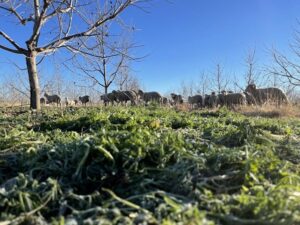
21 Aug 2021 – L18 (Photo 10) still a cold winter with sheep grazing under trees.
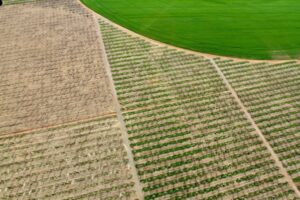
22 Aug 2021 – L18 (Photo 11) Aerial view on three different parts of the same orchard/development being grazed.
As shown above are three parts of the same orchard/development that has been grazed (to the top left of Photo 11), is being grazed (to the bottom left of Photo 11) and is going to be grazed (to the right of Photo 11). This is the power of livestock to change the cover of the soil and biomass production of these plants. The soil impact and plant stimulation lead to not only plant growth, reseed and regrowth but also microbial booms as new roots penetrate the soil, organic matter are trampled into the soil, and manure are being excreted.
Regenerative agriculture principles have been tested worldwide by pioneering farmers—or ‘regenerators,’ as Nicole Masters calls them. But how it will look on your farm or with your crop has to do with your specific area, climate dynamics and resource concerns. Use what you have and what works in your area. Put as much to the test as you can while learning from your mistakes.
Summary:
The approach we follow as to the covers we use, rotation times of sheep, and fertilization (type and quantity) is not the only recipe that works. Regenerative farming is about adapting your management to get as much as you can from the environment and having it do most of the heavy lifting. This does not mean it is less work.
Monitoring and correcting management leads to less work over time as you start to identify how your system works, where its potential lags are and where the speed is. Regenerative agriculture makes farming fun again. It is not a cookie cutter method, and it does not aim to give all the answers but asks you to know your land and area to increase your productivity per hectare.
Related Posts